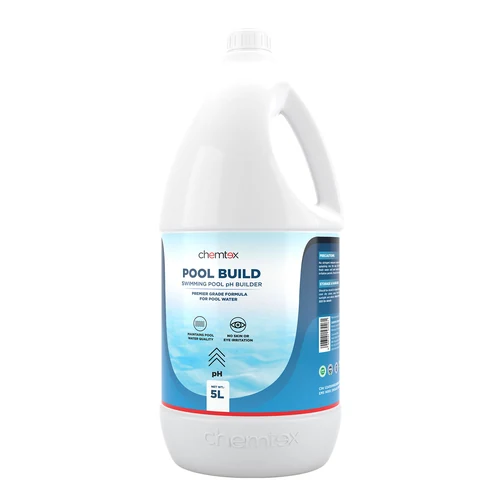
Home › Swimming Pool Chemicals › Pool Build — Swimming Pool Alkalinity Increaser, 1L
15% OFF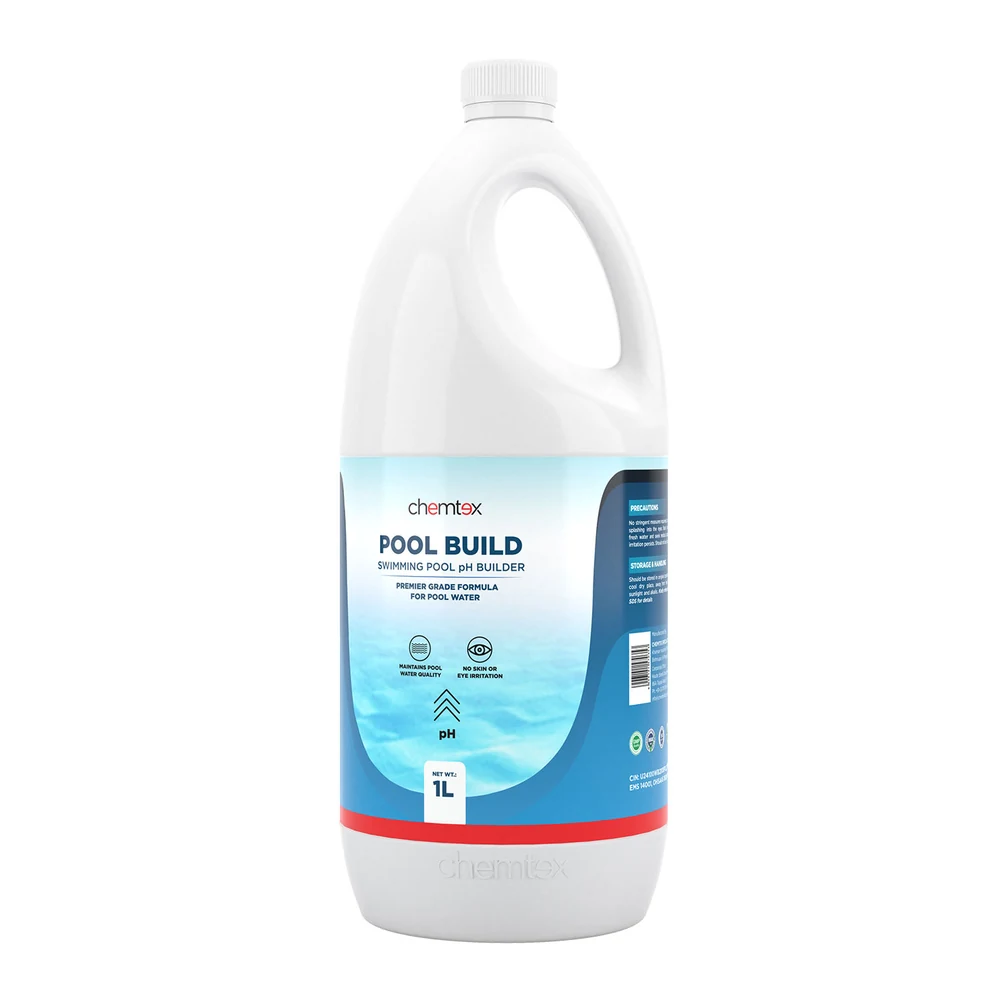
SKU SPPBLD1L
Pool Build — Swimming Pool Alkalinity Increaser, 1L
Liquid alkalinity increaser for swimming pools. Raises low pH to 7.2-7.6 and stops acid corrosion of fittings.
Be the first to review this product
₹1,105
₹1,299MRP
You save ₹194 (15% off)
Inclusive of all taxes · GST invoice provided
In stock · dispatched within 24 working hours
Free delivery
above ₹499
above ₹499
3–4 day delivery
across India
across India
Buying in bulk? Institutional pricing, custom pack sizes and GST invoicing available. Request a quote ›
PRODUCT DESCRIPTION
Chemtex Pool Build raises swimming pool pH and total alkalinity back into the 7.2-7.6 range. Acidic pool water stings eyes and nasal passages, strips the grout out of tiling, and quietly corrodes every metal component in the circuit - ladders, handrails, heat exchangers, pump internals. Low alkalinity also lets pH swing wildly on small additions, so nothing else you dose holds steady.
Dose against the tested pH. Per 10,000 litres of water that is 90 ml at pH 7.0-7.2, 115 ml at pH 6.8-7.0 and 140 ml at pH 6.5-6.7. A 1-litre bottle therefore covers seven to eleven full corrections of a 10,000-litre pool. Check total alkalinity as well as pH before dosing: above about 120 ppm, further additions start to cloud the water rather than help it.
Home pools go acidic for predictable reasons - rain, soft municipal water, and TCCA chlorine, which is itself mildly acidic and pulls pH down a little with every fortnightly dose. That last one catches most owners out: they dose chlorine correctly all season and watch the water turn stinging and the ladder start to corrode. A bottle of Pool Build alongside the chlorine is what keeps the two in balance.
FEATURES & BENEFITS
- Raises pH into 7.2-7.6 — The band where chlorine works, water stops stinging and pH stops swinging on every small addition.
- Stops acid corrosion — Acidic water eats ladders, handrails, heat exchangers, pump internals and tile grout. This is the cheap end of that problem.
- Buffers against pH swing — Building alkalinity is what makes pH hold. A pool with low alkalinity will not stay corrected however much pH chemical goes in.
- No swimmer irritation — No eye redness, skin irritation or allergy at dosing strength - unlike the acidic water it is correcting.
- Liquid, dose and go — Pre-diluted liquid measured against a pH reading. Nothing to weigh, dissolve or pre-mix.
HOW TO USE
- Test the water first — Use a pool test kit or strips before dosing. Dosing blind is how pools end up over-corrected, and a correction in the wrong direction costs a day of swimming.
- Work out your pool volume — Length (m) × width (m) × average depth (m) × 1,000 = volume in litres. A 10 m × 5 m pool averaging 1.4 m deep holds 70,000 litres. Every dose below is per litre of pool water, so this number is the only one you need.
- Read the dose off the pH — Per 50,000 litres: 450 ml at pH 7.0-7.2, 575 ml at pH 6.8-7.0, 700 ml at pH 6.5-6.7. A 10,000-litre pool needs a fifth of these.
- Check total alkalinity too — If total alkalinity is already above about 120 ppm, stop. Adding more will cloud the water instead of stabilising it.
- Dose, wait an hour, re-test — Pour around the periphery with the filtration running. Keep swimmers out for an hour, then re-test and correct in a second small step if needed.