Home › Swimming Pool Chemicals › Pool Drop — Swimming Pool pH Reducer, 5L Jar
25% OFF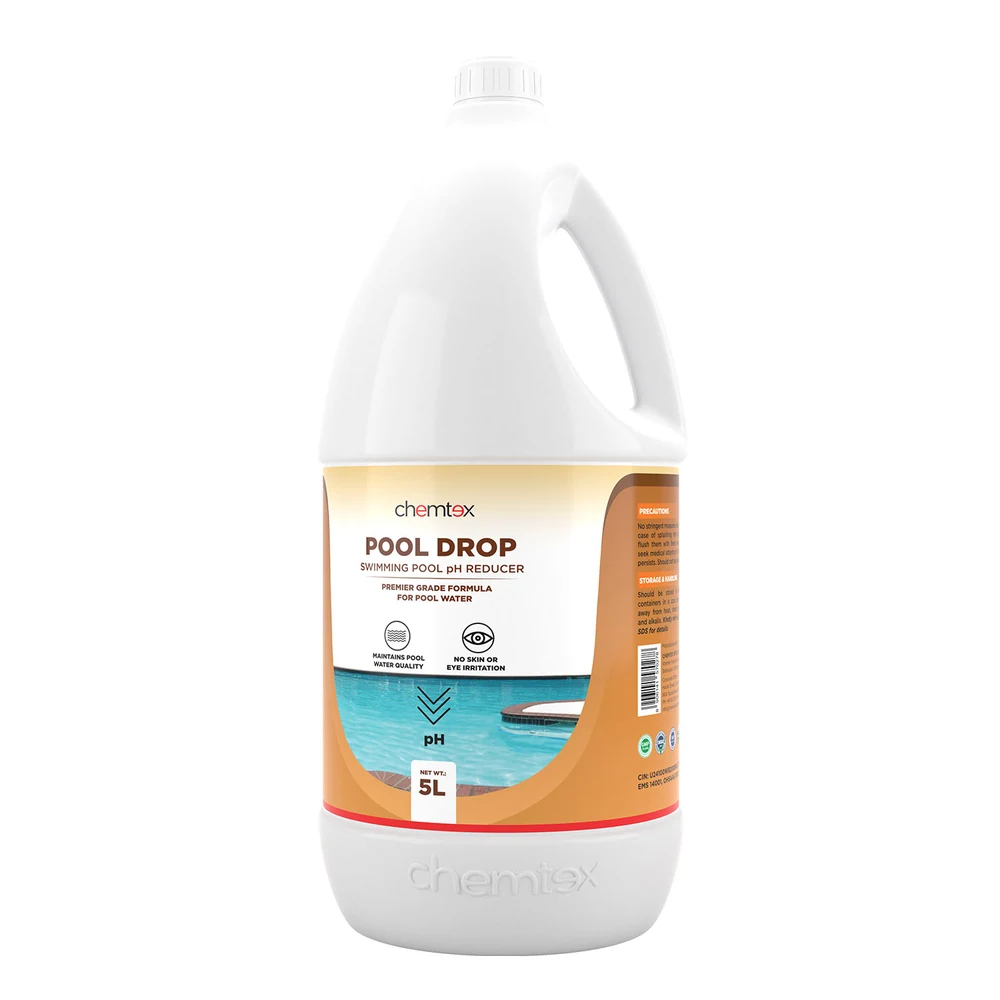
SKU SPPDRP5L
Pool Drop — Swimming Pool pH Reducer, 5L Jar
Liquid pool pH reducer in a 5L jar for club, hotel and society pools. Non-corrosive alternative to neat acid.
Be the first to review this product
₹3,374
₹4,499MRP
You save ₹1,125 (25% off)
Inclusive of all taxes · GST invoice provided
In stock · dispatched within 24 working hours
Free delivery
above ₹499
above ₹499
3–4 day delivery
across India
across India
Buying in bulk? Institutional pricing, custom pack sizes and GST invoicing available. Request a quote ›
PRODUCT DESCRIPTION
Chemtex Pool Drop lowers swimming pool pH back into the 7.2-7.6 range. Above that, water feels sticky and drying, swimmers report itchy skin and dull hair, scale starts forming on tiles and the heater element, and - the reason it matters most - chlorine loses much of its killing power. A pool at pH 8.2 is doing a fraction of the disinfection it was dosed for.
Dose against the tested pH, per 50,000 litres of water: 400 ml at pH 7.6-7.8, 500 ml at pH 7.8-8.0 and 800 ml above pH 8.0. A 1,00,000-litre pool therefore takes 800 ml to 1.6 litres per correction, so a 5-litre jar is six to twelve corrections of a 50,000-litre pool or three to six of a 1,00,000-litre one - a season of routine pH management for most commercial installations.
Commercial pools drift high, and they drift constantly: fresh make-up water, high alkalinity in Indian mains supply and TCCA dosing all push pH up between tests. A plant room that has to correct weekly gets through liquid, and a 5-litre jar is the difference between one delivery a season and a standing purchase order. Non-corrosive, so it can sit in the same room as the pumps and the dosing lines without shortening their life.
FEATURES & BENEFITS
- Holds pH at 7.2-7.6 — The band in which chlorine actually disinfects, scale does not form and the water stops stinging. Above it, your chlorine dose is largely wasted.
- Stops scale forming — High-pH water drops calcium onto tiles, grout, heater elements and the waterline. Correcting pH is cheaper than removing the scale afterwards.
- Non-corrosive — Will not pit ladders, handrails, light housings or filter internals, which is the standing risk with neat muriatic acid.
- No swimmer irritation — At dosing strength it causes no eye redness, skin irritation or allergy - the sticky, itchy feel of high-pH water goes away, nothing replaces it.
- Dose straight from the bottle — Liquid, pre-diluted and measured against a pH reading. No weighing, no dissolving, no acid handling drama.
HOW TO USE
- Test the water first — Use a pool test kit or strips before dosing. Dosing blind is how pools end up over-corrected, and a correction in the wrong direction costs a day of swimming.
- Work out your pool volume — Length (m) × width (m) × average depth (m) × 1,000 = volume in litres. A 10 m × 5 m pool averaging 1.4 m deep holds 70,000 litres. Every dose below is per litre of pool water, so this number is the only one you need.
- Read the dose off the pH — Per 50,000 litres: 400 ml at pH 7.6-7.8, 500 ml at pH 7.8-8.0, 800 ml above pH 8.0. Scale it to your own volume - a 10,000-litre pool needs a fifth of these.
- Dose along the periphery — Pour the measured quantity around the edge of the pool with the filtration running, so it mixes rather than sitting in one place.
- Wait an hour, then re-test — Keep swimmers out for at least an hour. Re-test and correct again if needed. Two small corrections are safer and more accurate than one large one.